
Engineering Guides and HVAC Formulas
Successful air distribution design involves more than product selection. It requires understanding how air moves through a space, how conditioned air is delivered and redistributed, and how engineering calculations support performance and comfort. We offer two practical engineering references to support both airside design and HVAC calculations.
Understanding Air Distribution and Indoor Climate Control
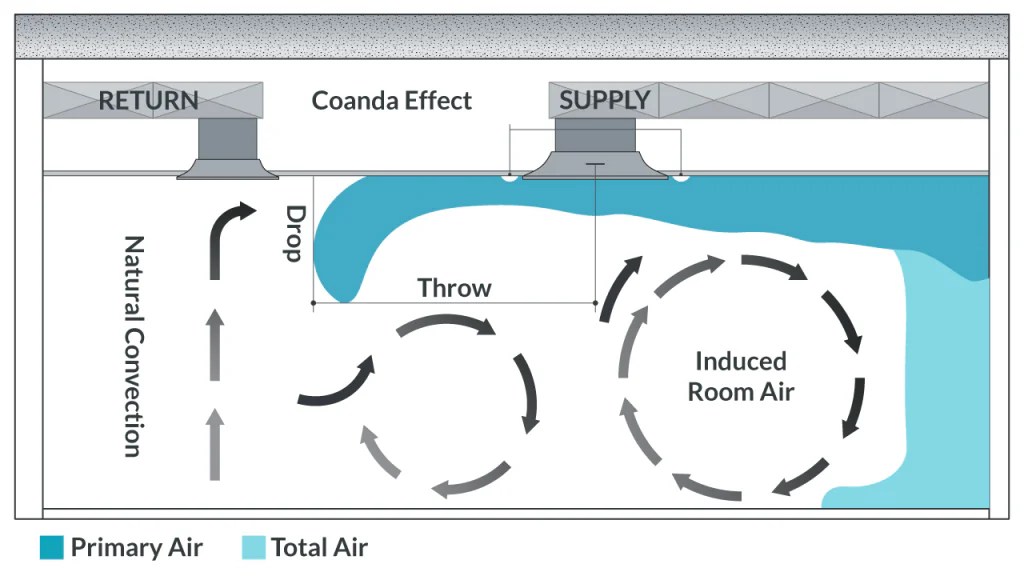
Air distribution plays a critical role in indoor climate control. It affects how heating and cooling are delivered, how air circulates through occupied spaces, and how temperature, ventilation, and comfort are maintained.
Conditioned air moves through duct systems and is introduced into the space through grilles, registers, diffusers, and other air distribution devices. These products help distribute supply air, promote proper mixing with room air, manage airflow patterns, and support the return or redistribution of air back through the HVAC system.
Air distribution is a core part of the airside system, working with ductwork, terminal units, air handling equipment, controls, and air control devices to help manage airflow, ventilation, pressure relationships, and occupant comfort.
When applied correctly, air distribution systems help reduce drafts, minimize hot and cold spots, improve ventilation effectiveness, and support a more comfortable and balanced indoor environment. Whether improving comfort in an office, supporting airflow in a healthcare environment, or distributing conditioned air in a large commercial facility, proper air distribution affects how a building performs day to day. Saturn supports these applications through proper product selection, application guidance, and related HVAC systems.
Air Distribution Engineering Guide
This guide focuses on airflow behavior and outlet performance, including comfort conditions, isothermal jets, the Coanda effect, throw, spread, drop, industrial ventilation, and air diffusion principles used in diffuser, grille, and register application. It is designed to support the engineering side of air distribution design and help users better understand how air moves within the built environment.
HVAC Engineering Formulas and Index
This guide serves as a practical quick reference for commonly used HVAC and mechanical calculations, including pressure relationships, velocity pressure conversion, sheet metal thickness and weight, round duct area, fraction and decimal conversions, mathematical formulas, measures of force and pressure, and metric conversions.
The formulas guide includes standard engineering relationships used in airflow, pressure, duct, and mechanical calculations and provides a practical reference for both design and field application.
Why These Resources Matter
Together, these guides provide a useful combination of air distribution engineering fundamentals and practical calculation tools to support design, coordination, and application. Whether evaluating airflow patterns, reviewing duct layouts, checking pressure relationships, or selecting products, these resources help support more informed decisions.