HVAC Systems for Commercial Buildings
Commercial HVAC systems are typically categorized into three primary system types: central hydronic systems, unitary (DX) systems, and variable refrigerant flow (VRF) systems. The primary distinction between these systems is how heating and cooling are generated and how that energy is distributed throughout the building.
Understanding these system types is essential for engineers, contractors, and building owners evaluating performance, efficiency, and long-term operational requirements in commercial HVAC design. Selecting the appropriate HVAC system depends on building type, load profile, ventilation requirements, control strategies, and long-term operational considerations.
Central Chilled Water VAV System with Hot Water Reheat
(Central Hydronic System)
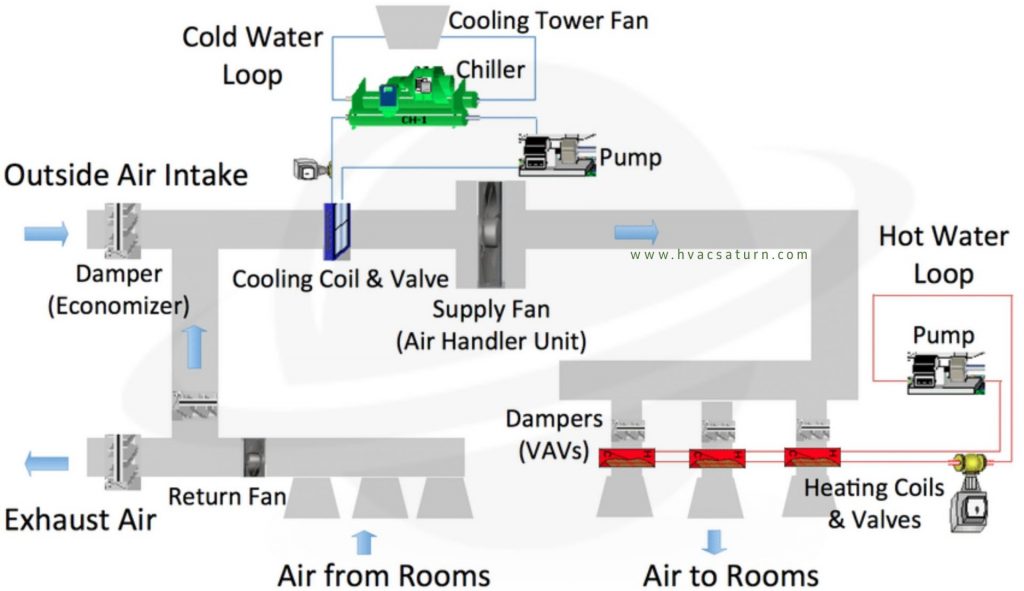
Central chilled water systems are built around a central plant that produces chilled water for cooling and hot water for heating. A cooling tower is typically used to reject heat from the chiller through a condenser water loop. In this configuration, water transports thermal energy throughout the building, while air delivers that energy to occupied spaces.
In a typical system, the chiller generates chilled water that is circulated to one or more Air Handling Units (AHUs). Within the AHU, return air from the building is mixed with outside air, filtered, and conditioned across cooling coils and, where applicable, heating coils. The conditioned air is then distributed through ductwork to the various zones of the building.
At the zone level, Variable Air Volume (VAV) terminal units regulate airflow based on demand. During cooling, the VAV modulates airflow to maintain space temperature. As loads decrease, airflow is reduced to a minimum setpoint, and a hot water reheat coil at the terminal unit maintains space temperature without overcooling. This allows the system to maintain different zone temperature requirements simultaneously while maintaining ventilation requirements and improving energy efficiency.
Heating is provided by a boiler system that distributes hot water to terminal reheat coils and, in some configurations, to heating coils within the AHU. The condenser water loop connects the chiller to the cooling tower, where heat absorbed from the building is rejected to the atmosphere, maintaining system efficiency and capacity.
These systems are typically integrated through a Building Automation System (BAS), which coordinates chiller operation, pumping systems, AHUs, and terminal units. In retrofit and modernization projects, updating controls, sequences of operation, and communication protocols is often one of the most effective ways to improve system performance, visibility, and long-term reliability.
Ventilation air may be introduced through the central AHU or through a Dedicated Outdoor Air System (DOAS), particularly in applications requiring tighter humidity control, pressurization, or code-driven ventilation rates.
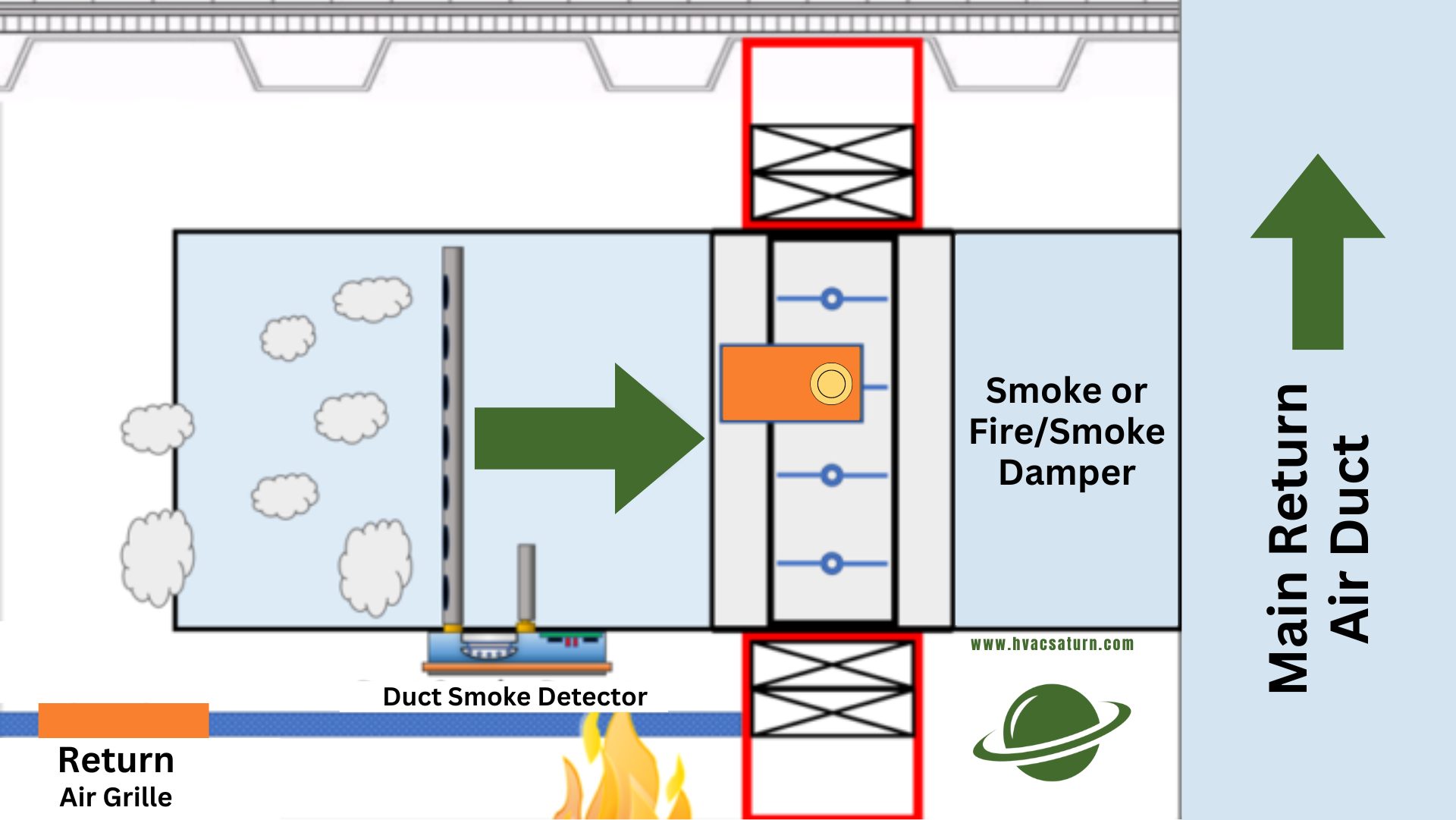
From an airside perspective, overall system performance is heavily dependent on proper distribution and control. Components such as Air Distribution (Grilles, Registers, Diffusers – GRDs), terminal units, control dampers (including fire and smoke dampers), louvers, duct silencers, and filtration systems all play a critical role in how air is delivered, controlled, and managed throughout the building. In more demanding environments, such as healthcare facilities, laboratories, and federal buildings, these components are essential to maintaining airflow direction, pressurization, and indoor air quality.
Summary
Central hydronic HVAC systems are most commonly used in large commercial buildings such as office towers, hospitals, laboratories, government facilities, and large-scale institutional projects where centralized heating and cooling generation and distributed zone control are required.
Key Considerations
Benefits
- Scalable for large buildings with many zones
- Centralized equipment simplifies long-term maintenance and system oversight
- Supports ventilation, humidity control, and pressurization requirements
- Well suited for healthcare, office towers, and critical environment applications
Drawbacks
- Higher initial cost due to central plant equipment and infrastructure
- Requires coordination between mechanical systems, controls, and airside components
- More complex design, installation, and commissioning process
Direct Expansion (DX) Air Conditioning Systems
(Packaged and Split Systems)
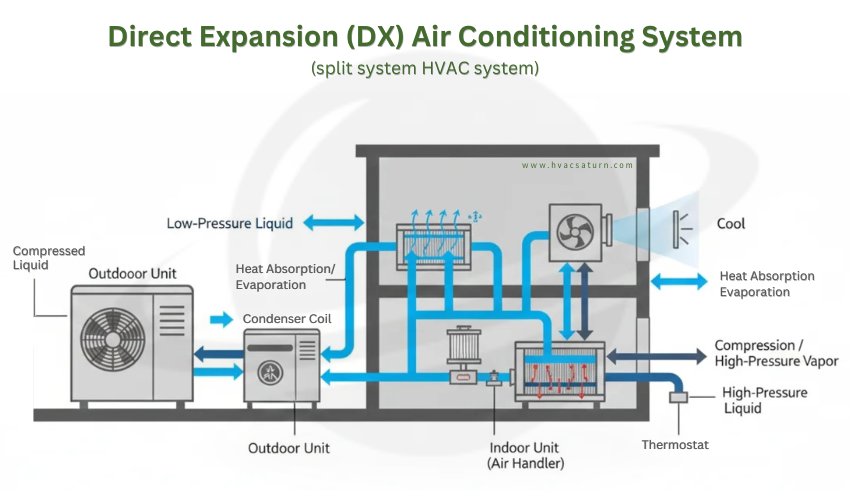
Unitary HVAC systems use direct expansion (DX), where refrigerant absorbs or rejects heat through a coil as air passes across it. In these systems, the compressor and condenser are located either in a packaged unit or in a separate outdoor unit, while the evaporator coil is located in the airstream. A fan delivers conditioned air through ductwork into the space.
Each unit typically serves a specific zone or area. As zoning requirements increase, additional units are typically required, which can impact coordination, available space, and maintenance.
Although the equipment is self-contained, proper air distribution and control are still required for the system to function as intended. Components such as Air Distribution (Grilles, Registers, Diffusers – GRDs), control dampers including fire and smoke dampers, louvers, electric duct heaters, and filtration systems and filter housings are used to manage airflow, maintain code compliance, and support indoor air quality.
Summary
Unitary (DX) systems are typically used in smaller commercial buildings such as retail spaces, restaurants, and low-rise office buildings where simplicity and lower initial cost are priorities.
Key Considerations
Benefits
- Lower first cost and simpler installation
- Self-contained equipment with minimal central infrastructure
- Straightforward operation and maintenance at small scale
Drawbacks
- Less efficient and harder to manage as the number of zones increases
- Multiple units increase maintenance points across the building
- Limited flexibility for larger or more complex applications
Variable Refrigerant Flow (VRF) Systems
Variable Refrigerant Flow (VRF) systems are refrigerant-based HVAC systems that vary refrigerant flow to multiple indoor units based on zone load. Outdoor units use inverter-driven compressors to adjust capacity in real time, and refrigerant is distributed through piping to indoor units serving different zones.
Each indoor unit modulates capacity independently based on zone conditions. In heat recovery configurations, heat can be transferred from one zone to another, allowing simultaneous heating and cooling in different areas.
VRF systems are typically used where zoning flexibility is required or where installing ductwork is impractical. Indoor units may be ducted or ductless depending on the design. Ventilation and filtration are typically handled by separate systems.
These systems are commonly applied in office buildings, hotels, multifamily buildings, and retrofit applications where space constraints and load variability are key considerations.
Summary
Variable Refrigerant Flow (VRF) systems are commonly applied in office buildings, hotels, multifamily residential buildings, and retrofit projects where zoning flexibility and space constraints are key factors.
Key Considerations
Benefits
- High efficiency at part-load conditions
- Flexible zoning with independent control at each indoor unit
- Reduced ductwork requirements in many applications
Drawbacks
- Higher upfront cost compared to traditional unitary systems
- Requires specialized design, installation, and commissioning
- Ventilation and humidity control must be addressed separately
A Note on Data Centers and Critical Applications
Certain applications, such as data centers, operate under different requirements than typical commercial HVAC systems. These environments are designed for continuous operation and require precise control of airflow, temperature, and cleanliness.
These systems typically rely on close-control cooling systems such as CRAC or CRAH units, with airflow management strategies designed to support high-density loads.
In these applications, performance is driven by airflow management, pressure relationships, and filtration rather than comfort-based temperature control alone. Airside components play a central role, including Air Distribution (Grilles, Registers, Diffusers – GRDs), underfloor air distribution (UFAD) systems, control dampers (including fire and smoke dampers), louvers, and filtration systems and filter housings. Custom Air Handling Units (AHUs) and duct silencers may also be incorporated depending on the system design.
System Integration
HVAC system performance depends on how well the equipment and airside components are integrated. The major mechanical equipment provides capacity, but the airside system determines how that capacity is delivered and controlled within the building.
Control strategies, typically implemented through a Building Automation System (BAS), coordinate equipment operation, airflow, temperature control, and energy performance across the building.
Key components include:
- Air Distribution (Grilles, Registers, Diffusers) GRDs
- Dampers / Fire Smoke Dampers
- Louvers
- Terminal Units (VAVs)
- Fan Coil Units
- Water Source Heat Pumps
- Custom Air Handlers
- Electric Duct Heaters
- Silencers
- Filtration Systems / Filter Housings
- Critical Environment
These elements determine airflow patterns, control strategies, and overall system performance. Central hydronic systems are typically used in larger buildings where centralized generation and distributed control are required. Unitary systems are used where simpler, zone-based solutions are sufficient. VRF systems are applied where zoning flexibility and space constraints drive system selection. System selection is based on building type, load profile, control requirements, and long-term operational considerations.
Contact Us
For upcoming projects, reach out for support with HVAC system components, product selection, and competitive pricing. Contact us by phone, email, or through the form below for prompt support.
Customer Service: customerservice@hvacsaturn.com
Partnership Opportunities: partners@hvacsaturn.com
Main Office: 817.293.8059