Author name: Saturn Enterprises, Inc.

Saturn Enterprises, Inc., a Texas-based minority and woman-owned small business, has proudly served clients since 1994. Specializing in innovative building solutions such as building automation, high-efficiency HVAC systems, and more for commercial, industrial, healthcare, and educational facilities, we are renowned for our commitment to excellence and customer satisfaction. Our expertise has led to consulting and project management of federal contracts for the retrofit and upgrade of Building Automation Systems (BAS) in federal buildings.

Effect of Ceilings on Room Sound Levels

Full Ceiling – Area Source:

When a room boasts a complete ceiling that spans from wall to wall, it serves as a barrier, isolating the room from the area above it. This overhead space is often utilized for the return air path to the air handler, as well as for mounting mechanical equipment, plumbing, electrical supplies, and lighting. This open space becomes a distinct area separated from the occupied space below. Consequently, sound generated in the return plenum disperses throughout the plenum, creating an area sound source that evenly permeates the entire ceiling into the space below. AHRI Standard 885 outlines how the sound from mechanical equipment is impacted as it enters the occupied space. Sound measurements in the occupied space remain relatively constant across the entire floor area in the room.
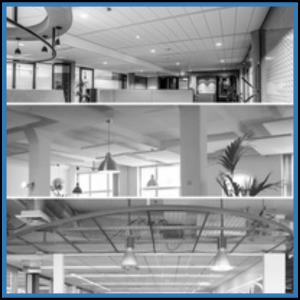
No Ceiling – Point Source:

In the absence of a ceiling, the sound generated by mechanical equipment doesn’t enter the occupied space in the same way as when a ceiling is present. The sound source transforms into a point source, predominantly influenced by the distance between the source and the receiver. It may also be reflected from various equipment in the upper part of the room and directed towards specific areas in the occupied space. With only one overall space, the room volume increases. While AHRI Standard 885 provides a method for predicting sound levels in the occupied space under this condition, it tends to be overly optimistic. Measured attenuation values in each octave band differ significantly from predictions made with and without a ceiling. Attempts to achieve acceptable NC values in the occupied space without a ceiling often lead to oversized mechanical equipment to reduce noise. Furthermore, equipment sound levels tend to shift towards higher octave bands, adding to diffuser noise. Sound readings in the occupied space vary widely across the entire floor area, dissipating with increasing distance from the equipment.

Cloud or Floating Ceilings:

Cloud ceilings or floating ceilings are partially suspended, not extending from wall to wall. They are commonly used to conceal mechanical equipment in the upper part of the room or to enhance the room’s height near perimeter glass for a larger view. Under optimal conditions, room NC levels with cloud ceilings may not be better than those without a ceiling. Some areas might experience higher noise levels as noise from above the ceiling is concentrated on specific spots or areas in the occupied space.

Exercise caution when predicting room noise levels with partial or no ceilings, as the values can significantly differ from those in a space with a full ceiling.

Effect of Ceilings on Room Sound Levels Read More »

American Express: Torre Del Angel

Saturn Enterprises, Inc. proudly contributed to the modernization of the American Express headquarters in Mexico City, located at Reforma 350, also known as Torre del Angel. This iconic 21-story building on Paseo de la Reforma, Mexico City’s most prestigious avenue, is situated at the Plaza of the Angel of Independence, the city’s best-known monument.

Enhancing Efficiency and Quality

Our project featured cutting-edge building automation solutions, including high-performance fan-powered Variable Air Volume (VAV) systems and advanced controls. Our work at Torre del Angel involved implementing state-of-the-art systems to boost energy efficiency and indoor environment quality. This redevelopment of an existing 1980s vintage building was led by renowned architect Robert A.M. Stern, transforming it into an International Class A office space and ensuring a comfortable and productive environment for American Express employees.

Hines, along with its Mexican partners, invested approximately $23 million over two years for a complete renovation. Robert A.M. Stern collaborated with a team of both Mexican and U.S. architects, engineers, and consultants like Saturn Enterprises to achieve the desired transformation. Torre del Angel is located in the principal financial, commercial, and hotel district of downtown Mexico City. The building, covered with shining glass and designed by Robert Stern, stands as an attractive feature for business and tourism. This exquisite address overlooks the famous Angel of Independence monument, one of Mexico’s most representative landmarks, symbolizing freedom and governance.

Project Details

  • Location & Year: Mexico City, Mexico
  • Category: High-rise Office, Redevelopment
  • Stories: 21
  • Size: 271,000 SF

Location Map

Commitment to Excellence

With over three decades of experience, Saturn Enterprises specializes in innovative solutions for commercial, industrial, healthcare, and educational facilities. Our role in this project underscores our dedication to delivering top-quality, efficient systems from start to finish.

American Express: Torre Del Angel Read More »

Scroll to Top