News

HVAC Systems for Commercial Buildings

Commercial HVAC systems are typically categorized into three primary system types: central hydronic systems, unitary (DX) systems, and variable refrigerant flow (VRF) systems. The primary distinction between these systems is how heating and cooling are generated and how that energy is distributed throughout the building.

Understanding these system types is essential for engineers, contractors, and building owners evaluating performance, efficiency, and long-term operational requirements in commercial HVAC design. Selecting the appropriate HVAC system depends on building type, load profile, ventilation requirements, control strategies, and long-term operational considerations.


Central Chilled Water VAV System with Hot Water Reheat
(Central Hydronic System)

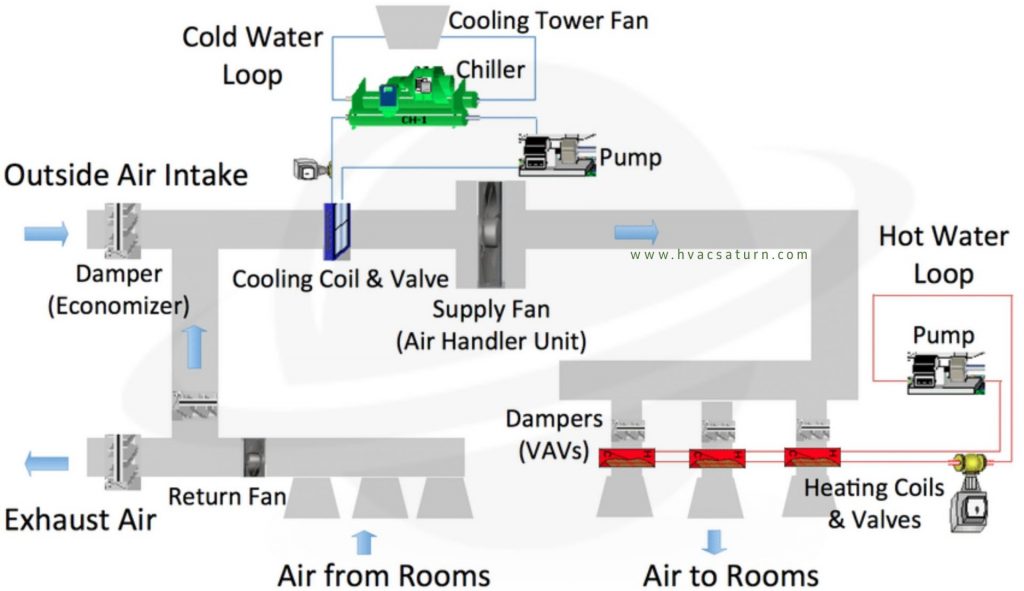
Central chilled water systems are built around a central plant that produces chilled water for cooling and hot water for heating. A cooling tower is typically used to reject heat from the chiller through a condenser water loop. In this configuration, water transports thermal energy throughout the building, while air delivers that energy to occupied spaces.

In a typical system, the chiller generates chilled water that is circulated to one or more Air Handling Units (AHUs). Within the AHU, return air from the building is mixed with outside air, filtered, and conditioned across cooling coils and, where applicable, heating coils. The conditioned air is then distributed through ductwork to the various zones of the building.

At the zone level, Variable Air Volume (VAV) terminal units regulate airflow based on demand. During cooling, the VAV modulates airflow to maintain space temperature. As loads decrease, airflow is reduced to a minimum setpoint, and a hot water reheat coil at the terminal unit maintains space temperature without overcooling. This allows the system to maintain different zone temperature requirements simultaneously while maintaining ventilation requirements and improving energy efficiency.

Heating is provided by a boiler system that distributes hot water to terminal reheat coils and, in some configurations, to heating coils within the AHU. The condenser water loop connects the chiller to the cooling tower, where heat absorbed from the building is rejected to the atmosphere, maintaining system efficiency and capacity.

These systems are typically integrated through a Building Automation System (BAS), which coordinates chiller operation, pumping systems, AHUs, and terminal units. In retrofit and modernization projects, updating controls, sequences of operation, and communication protocols is often one of the most effective ways to improve system performance, visibility, and long-term reliability.

Ventilation air may be introduced through the central AHU or through a Dedicated Outdoor Air System (DOAS), particularly in applications requiring tighter humidity control, pressurization, or code-driven ventilation rates.

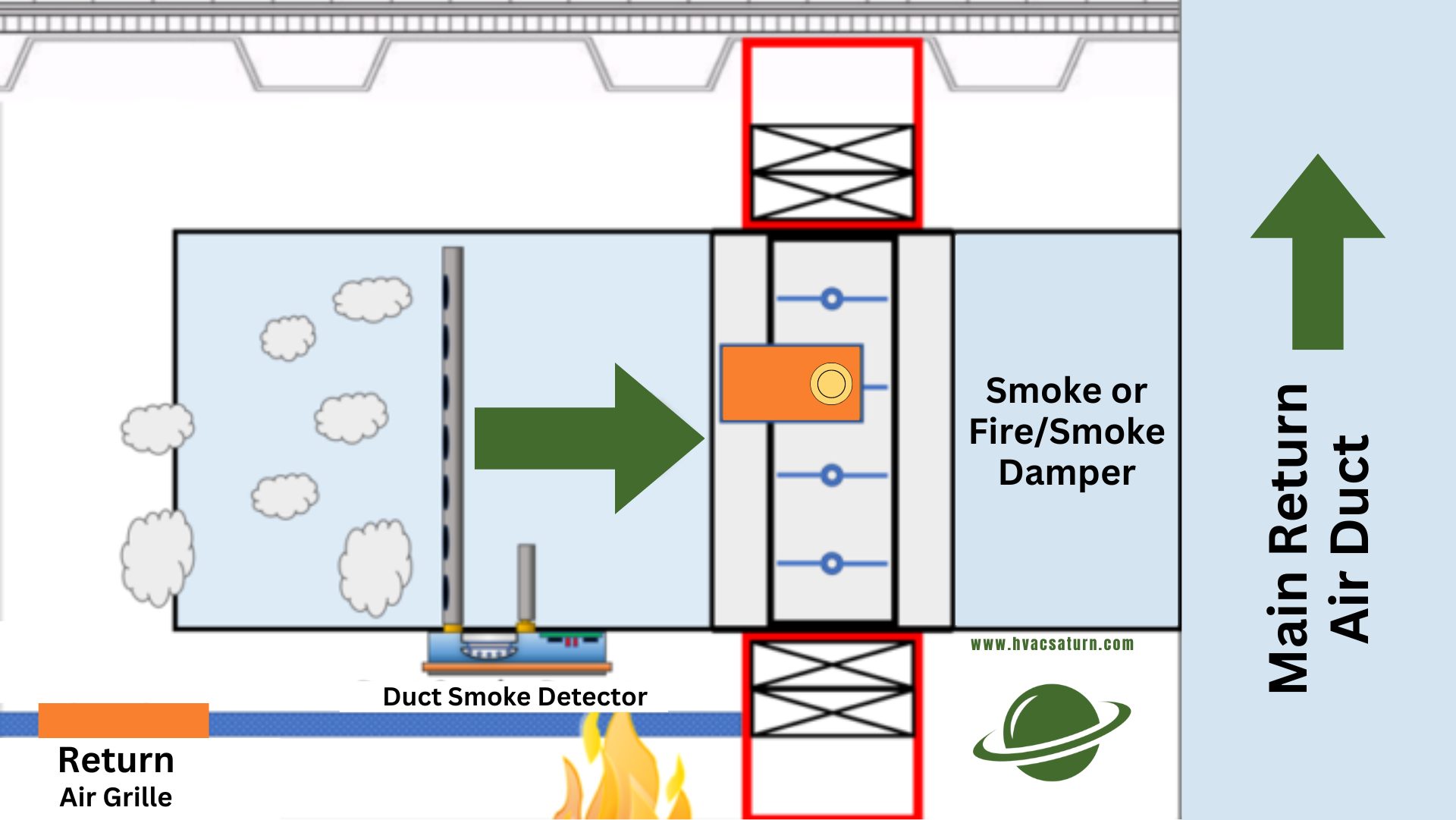
From an airside perspective, overall system performance is heavily dependent on proper distribution and control. Components such as Air Distribution (Grilles, Registers, Diffusers – GRDs), terminal units, control dampers (including fire and smoke dampers), louvers, duct silencers, and filtration systems all play a critical role in how air is delivered, controlled, and managed throughout the building. In more demanding environments, such as healthcare facilities, laboratories, and federal buildings, these components are essential to maintaining airflow direction, pressurization, and indoor air quality.

Summary

Central hydronic HVAC systems are most commonly used in large commercial buildings such as office towers, hospitals, laboratories, government facilities, and large-scale institutional projects where centralized heating and cooling generation and distributed zone control are required.

Key Considerations
Benefits
  • Scalable for large buildings with many zones
  • Centralized equipment simplifies long-term maintenance and system oversight
  • Supports ventilation, humidity control, and pressurization requirements
  • Well suited for healthcare, office towers, and critical environment applications
Drawbacks
  • Higher initial cost due to central plant equipment and infrastructure
  • Requires coordination between mechanical systems, controls, and airside components
  • More complex design, installation, and commissioning process

Direct Expansion (DX) Air Conditioning Systems
(Packaged and Split Systems)
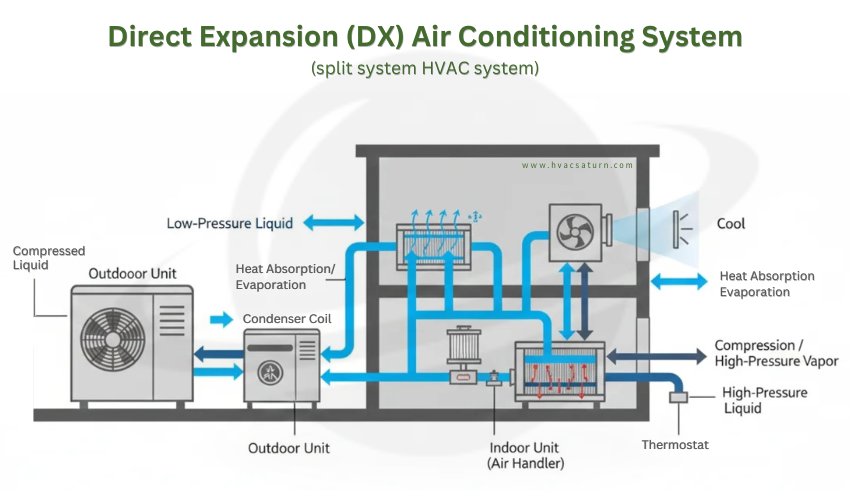
Unitary HVAC systems use direct expansion (DX), where refrigerant absorbs or rejects heat through a coil as air passes across it. In these systems, the compressor and condenser are located either in a packaged unit or in a separate outdoor unit, while the evaporator coil is located in the airstream. A fan delivers conditioned air through ductwork into the space.

Each unit typically serves a specific zone or area. As zoning requirements increase, additional units are typically required, which can impact coordination, available space, and maintenance.

Although the equipment is self-contained, proper air distribution and control are still required for the system to function as intended. Components such as Air Distribution (Grilles, Registers, Diffusers – GRDs), control dampers including fire and smoke dampers, louvers, electric duct heaters, and filtration systems and filter housings are used to manage airflow, maintain code compliance, and support indoor air quality.

Summary

Unitary (DX) systems are typically used in smaller commercial buildings such as retail spaces, restaurants, and low-rise office buildings where simplicity and lower initial cost are priorities.

Key Considerations
Benefits
  • Lower first cost and simpler installation
  • Self-contained equipment with minimal central infrastructure
  • Straightforward operation and maintenance at small scale
Drawbacks
  • Less efficient and harder to manage as the number of zones increases
  • Multiple units increase maintenance points across the building
  • Limited flexibility for larger or more complex applications

Variable Refrigerant Flow (VRF) Systems

Variable Refrigerant Flow (VRF) systems are refrigerant-based HVAC systems that vary refrigerant flow to multiple indoor units based on zone load. Outdoor units use inverter-driven compressors to adjust capacity in real time, and refrigerant is distributed through piping to indoor units serving different zones.

Each indoor unit modulates capacity independently based on zone conditions. In heat recovery configurations, heat can be transferred from one zone to another, allowing simultaneous heating and cooling in different areas.

VRF systems are typically used where zoning flexibility is required or where installing ductwork is impractical. Indoor units may be ducted or ductless depending on the design. Ventilation and filtration are typically handled by separate systems.

These systems are commonly applied in office buildings, hotels, multifamily buildings, and retrofit applications where space constraints and load variability are key considerations.

Summary

Variable Refrigerant Flow (VRF) systems are commonly applied in office buildings, hotels, multifamily residential buildings, and retrofit projects where zoning flexibility and space constraints are key factors.

Key Considerations
Benefits
  • High efficiency at part-load conditions
  • Flexible zoning with independent control at each indoor unit
  • Reduced ductwork requirements in many applications
Drawbacks
  • Higher upfront cost compared to traditional unitary systems
  • Requires specialized design, installation, and commissioning
  • Ventilation and humidity control must be addressed separately

A Note on Data Centers and Critical Applications

Certain applications, such as data centers, operate under different requirements than typical commercial HVAC systems. These environments are designed for continuous operation and require precise control of airflow, temperature, and cleanliness.

These systems typically rely on close-control cooling systems such as CRAC or CRAH units, with airflow management strategies designed to support high-density loads.

In these applications, performance is driven by airflow management, pressure relationships, and filtration rather than comfort-based temperature control alone. Airside components play a central role, including Air Distribution (Grilles, Registers, Diffusers – GRDs), underfloor air distribution (UFAD) systems, control dampers (including fire and smoke dampers), louvers, and filtration systems and filter housings. Custom Air Handling Units (AHUs) and duct silencers may also be incorporated depending on the system design.


System Integration

HVAC system performance depends on how well the equipment and airside components are integrated. The major mechanical equipment provides capacity, but the airside system determines how that capacity is delivered and controlled within the building.

Control strategies, typically implemented through a Building Automation System (BAS), coordinate equipment operation, airflow, temperature control, and energy performance across the building.

Key components include:

These elements determine airflow patterns, control strategies, and overall system performance. Central hydronic systems are typically used in larger buildings where centralized generation and distributed control are required. Unitary systems are used where simpler, zone-based solutions are sufficient. VRF systems are applied where zoning flexibility and space constraints drive system selection. System selection is based on building type, load profile, control requirements, and long-term operational considerations.


Contact Us

For upcoming projects, reach out for support with HVAC system components, product selection, and competitive pricing. Contact us by phone, email, or through the form below for prompt support.
Customer Service: customerservice@hvacsaturn.com
Partnership Opportunities: partners@hvacsaturn.com
Main Office: 817.293.8059

Name
Select Product/Service

HVAC Systems for Commercial Buildings Read More »
Investing in Mexico: Strategy and Continued Growth

Mexico remains one of the most important infrastructure and manufacturing markets in North America. For Saturn, our presence in Mexico reflects more than expansion. It represents decades of partnership, collaboration, and strategic growth within the HVAC and building automation industry.

Recent security operations in the state of Jalisco have generated widespread news coverage. Mexican authorities conducted a targeted military action against leadership of a major organized crime group. In the immediate aftermath, there were coordinated retaliatory incidents and temporary disruptions in certain regions, including transportation corridors and airport activity.

While these events are serious and visible, they do not represent a breakdown of Mexico’s economy or its role in North American commerce. Airport operations were temporarily affected but have continued under security oversight, and normal commercial activity has been resuming.

It is important to separate fact from perception. Some online narratives suggested that major infrastructure had been overtaken or fully compromised. Verified reporting confirms that those claims were inaccurate. The events were localized responses to a specific security operation, not systemic collapse. Mexico continues to function as a vital hub for manufacturing, logistics, infrastructure modernization, and commercial construction.

The Strength of the Mexico Infrastructure Market

Mexico remains a key player in commercial construction and industrial development. Demand for energy efficient HVAC systems continues across commercial, industrial, healthcare, and institutional sectors.

The need for improved indoor air quality and efficient systems is increasing as facilities modernize and energy standards evolve. Engineers, contractors, and facility managers across Mexico continue to design and implement high performance systems that meet these growing expectations. The underlying fundamentals of the Mexico HVAC market remain strong. Infrastructure investment, manufacturing expansion, and cross border trade continue to support long term opportunity.

Responsible Leadership and Operational Stability

At Saturn, we approach international markets with preparation and discipline. We monitor developments through verified sources and maintain ongoing communication with our partners on the ground. Safety, situational awareness, and supply chain stability are central to our operational planning.

We continue to evaluate logistics, travel, and project coordination carefully. Our vendor relationships remain active and stable. Our customers continue to receive the same level of technical support and service excellence they expect. International business requires thoughtful leadership. It requires confidence balanced with awareness. We lead with both.

Our strategy in Mexico is not temporary or reactionary. It is a continuation of longstanding collaboration partners who value reliability and performance. Growth for Saturn means strengthening cross border partnerships and delivering consistent solutions that improve building performance and reduce operating costs. We are continuing to build on decades of experience serving Latin America and supporting complex projects.

Temporary disruptions do not alter the long term trajectory of infrastructure modernization in Mexico. The need for efficient systems and sustainable building design remains steady.

Over 30 Years of International Experience and Performance

For more than 30 years, we have navigated economic cycles, regulatory shifts, and regional challenges before. Each time, our disciplined operations, strong manufacturer relationships, and commitment to customer satisfaction have allowed us to continue expanding responsibly.

Today, as we continue strengthening our Mexico partnerships, our focus remains clear.

We remain present.
We remain prepared.

Saturn will continue delivering reliable building solutions and long-term value to our customers and vendors in Mexico and beyond.

Investing in Mexico:Strategy and Continued Growth Read More »

Saturn’s Contribution to Mexico’s Next Phase of Growth

As Mexico enters a major phase of commercial and industrial expansion, Saturn Enterprises, Inc. is proud to contribute to the country’s development. We’re supporting key projects across the region by supplying high-quality HVAC systems that help shape efficient, comfortable, and future-ready buildings.

With more than 30 years of experience across Latin America and the Caribbean, Saturn has built long-standing relationships with developers, contractors, and government agencies. Our expertise and trusted supplier network allow us to meet the rising demand for energy-efficient, performance-driven HVAC solutions across a wide variety of building types.

Meeting the Moment: Walmart de Mexico Expansion

One of the most significant developments driving Mexico’s infrastructure growth is Walmart de México y Centroamérica’s recently announced $6 billion investment. This ambitious plan includes opening approximately 2,500 new retail locations and building state-of-the-art distribution centers across the country. It’s expected to create thousands of jobs and fuel large-scale infrastructure development in every region.

Saturn Enterprises is directly involved in supporting these projects by supplying HVAC systems that meet the evolving demands of modern building design ensuring efficiency and long-term performance. Walmart already operates in over 580 cities nationwide, using three distinct formats to meet market needs: Bodega Aurrera, Mi Bodega Aurrera, and Bodega Aurrera Express. One of the newest additions, located in Mexicali, joins the 31 Bodega Aurrera locations already serving customers in Baja California.

As new and existing facilities are constructed to higher standards of comfort, efficiency, and scalability, Saturn is proud to support these efforts supplying the HVAC systems that help modern buildings perform at their best and stand ready for the future.

Building Better Environments

From retail stores and distribution centers to public institutions and high-rise buildings, Saturn supplies the HVAC systems that support:

Our product lines include:

With reliable equipment from brands like Nailor and others, Saturn plays a key role in delivering the systems behind many of Mexico’s most prominent commercial and infrastructure projects.

Looking Ahead

We understand how critical timing, communication, and accuracy are especially on large-scale projects with tight construction schedules. Our team works closely with project stakeholders to ensure the right systems are delivered on time and ready to perform. This reliability has positioned Saturn as a trusted partner on major developments across Mexico and Latin America, including those backed by national and international investment.

Mexico’s infrastructure boom is just getting underway. Industrial real estate is thriving—CBRE reports millions of square meters under development in regions like Mexico City, Monterrey, and the Bajío. Amid this growth, Saturn is committed to supporting smarter, more sustainable buildings bringing HVAC solutions that deliver economic, operational, and environmental benefits.

Let’s Connect

If your next project needs dependable HVAC systems and a partner who understands what’s at stake, we’re ready to help.

Saturn’s Contribution to Mexico’s Next Phase of Growth Read More »

Building Automation Across Texas

Saturn is excited to announce our latest project in GSA Region 7, delivered in partnership with OPIX Systems, LLC. This effort focused on upgrading and modernizing Building Automation Systems (BAS) across federal facilities in Austin, Fort Worth, and Midland, Texas, supporting long-term operational efficiency, improved system visibility, and reliable building operations.

Building Automation Systems (BAS)

Building Automation Systems are all about making buildings smarter, more efficient, and easier to manage. Saturn designs and implements BAS solutions that help facility teams understand what their buildings are doing and make informed decisions in real time.

Our scope includes controls upgrades, BACnet IP system integration, and custom graphics that simplify daily operation while supporting long-term maintenance and reliability. Each system is designed to meet federal cybersecurity and compliance requirements while remaining practical and intuitive for onsite teams.

UPDATE: Successful Project Completion

Saturn, along with our partner firms, has successfully completed all three federal building upgrades as part of this GSA Region 7 initiative. Each project replaced aging legacy systems with modern BACnet IP controllers tied into critical HVAC and lighting systems, improving performance, reliability, and operational efficiency.

Fritz G. Lanham Federal Building
Fort Worth, Texas

The Fritz G. Lanham Federal Building BAS upgrade focused on modernizing legacy controls to improve system reliability and visibility for facility operators. The project included BACnet IP integration, updated control logic, and custom graphics that allow onsite teams to better monitor and manage building performance.

George H.W. Bush Federal Building
Midland, Texas

At the George H.W. Bush Federal Building, Saturn completed a full BAS upgrade replacing outdated control systems with modern BACnet IP controllers. The improvements enhanced operational efficiency, improved system responsiveness, and provided clearer insight into HVAC performance across the facility.

Homer Thornberry Federal Building
Austin, Texas

The Homer Thornberry Federal Building BAS upgrade involved integrating new BACnet IP controllers with existing HVAC infrastructure while maintaining continuous building operations. The project delivered improved system visibility, reliable control sequences, and graphics designed to support long-term facility management.

These completed projects support GSA and Department of the Interior goals by reducing energy consumption, lowering operating costs, and improving overall system performance. By utilizing American-made materials and proven technology, Saturn continues to deliver practical, secure, and reliable building automation solutions for mission-critical federal facilities.

With Saturn’s recent 8(a) certification through the U.S. Small Business Administration, we are continuing to expand our work within the federal sector while maintaining our commitment to quality, safety, and long-term performance.

Together, we’re helping to shape a future that’s environmentally responsible and reduces the carbon footprint of federal facilities.

GSA Region Map

GSA Region 7: Federal BAS Upgrades Read More »

Saturn Enterprises, Inc. SBA WOSB and EDWOSB Certifications

Dallas/Fort Worth, TX — February 19, 2025 — Saturn Enterprises, Inc., an innovative building solutions firm, is proud to announce its official certifications as a Women-Owned Small Business (WOSB) and an Economically Disadvantaged Women-Owned Small Business (EDWOSB) by the U.S. Small Business Administration (SBA). You can learn more about the program in FAQs WOSB/EDWOSB.

These new designations build upon Saturn’s SBA 8(a) certification, awarded in September 2024, and further solidify the company’s commitment to growth and leadership in the government sectors.

Maria Menzies, President of Saturn Enterprises, shared her excitement:

“We are honored to be recognized by the SBA as both a WOSB and EDWOSB. Along with our 8(a) certification, these programs open even more doors for us to expand into federal contracting while continuing to deliver the high-quality solutions our clients trust. These certifications reflect not only our history of success but also our vision for the future as we scale our business and create opportunities for lasting impact.”

What are the WOSB EDWOSB Certifications?

The Women-Owned Small Business program is designed to provide greater access to federal contracting opportunities for women-owned companies in underrepresented industries. To qualify, a business must be at least 51% owned and controlled by women. The Economically Disadvantaged Women-Owned Small Business designation is an extension of the WOSB program, offering additional support to businesses owned by women who meet specific economic criteria. This certification gives Saturn increased access to federal contracts reserved for EDWOSB participants.

Why These Certifications Matter

With WOSB and EDWOSB certifications, Saturn gains:

  • Eligibility for set-aside federal contracts reserved exclusively for certified WOSB and EDWOSB companies.
  • Stronger positioning to build long-term partnerships with government agencies.
  • Expanded opportunities to deliver innovative building solutions. From targeted construction improvements to automation and HVAC, we that reduce costs and drive operational efficiency.

These certifications, combined with Saturn’s existing 8(a), MBE, WBE, and SBE designations, further establish the company as a trusted partner in both the public and private sectors.

Saturn Enterprises remains committed to delivering sustainable and cost-effective solutions for government and commercial clients alike. Choose Saturn as your trusted partner for tailored solutions and unmatched reliability. View a summary of our past performance on our Capabilities Statement (pdf)

Saturn Enterprises, Inc. SBA WOSB and EDWOSB Certifications Read More »

Saturn is excited to have participated in the 2024 SAME Federal Small Business Conference (SBC) in New Orleans, a key event connecting industry leaders, government decision-makers, and small businesses in the federal A/E/C market. This milestone opportunity aligns with our mission to expand into the federal market, leveraging our SBA 8(a) and Minority- and Woman-Owned Small Business Certifications to drive project success while fostering impactful partnerships.

The conference offered invaluable experiences, from engaging in curated educational talks to participating in matched networking appointments with federal agencies and industry leaders. We attended sessions led by senior government officials, including Lt. Gen. William Graham and other top engineering leaders, emphasizing the critical role small businesses like Saturn play in driving innovation, delivering timely solutions, and building partnerships for the future.

As a small business with over 30 years of expertise in high-efficiency HVAC systems, building automation (BAS), and targeted construction improvements, Saturn is enthusiastic about the opportunities to partner with federal agencies and contractors to meet pressing challenges. The insights and connections gained at SBC 2024 will support our continued growth in delivering innovative solutions that reduce operating costs and optimize building performance.

This conference was more than an event; it was a step forward in strengthening our network, broadening our impact, and driving our vision of expanding our services. We’re energized by the connections made and look forward to building on these partnerships to achieve success in the federal market.

Strength in Partnerships: the SAME Federal Small Business Conference 2024 Read More »

Saturn Enterprises, Inc. Achieves MBE, WBE, and SBE Certification

Dallas/Fort Worth, TX — November 11, 2024 — Saturn Enterprises, Inc. (www.hvacsaturn.com), an innovative building solutions firm, is proud to announce its official certifications as an MBE (Minority Business Enterprise), WBE (Women Business Enterprise), and SBE (Small Business Enterprise) certifications through the North and South Central Texas Regional Certification Agencies. These certifications mark a significant milestone, along with their recent 8(a) certification in their commitment to economic inclusion and diversity in the industries we serve.

Saturn’s President, Maria Menzies, shared her excitement, “After over 30 years of serving our international clients, we’re thrilled to reach this milestone with our Women- and Minority-Owned Small Business certifications. This achievement unlocks new opportunities, enabling us to expand into additional markets while continuing to invest in our future. We look forward to providing the same high-quality products and services that our clients trust and rely on.”

What Is MBE Certification?

An MBE (Minority Business Enterprise) certification demonstrates that a business is at least 51% owned, managed, and controlled by one or more individuals from a minority group. This includes U.S. citizens who identify as Asian-Indian, Asian-Pacific, Black, Hispanic, or Native American.

What is WBE Certification?

WBE (Women Business Enterprise) certification is awarded to companies that are at least 51% owned, controlled, operated, and managed by one or more women. This certification helps us further represent women’s contributions to the business landscape, especially in fields like building automation, where women are gaining momentum to drive innovation and new perspectives.

What is SBE Certification?

SBE (Small Business Enterprise) certification recognizes companies that meet specific size criteria for small businesses as defined by industry standards. As an SBE-certified company, Saturn is acknowledged as a small business that brings personalized service and dedication to each project.

About the North Central Texas Regional Certification Agency

The North Central Texas Regional Certification Agency NCTRCA is a nonprofit organization that works with cities, schools, transit authorities, and public agencies across the Dallas–Fort Worth metropolitan area, including Dallas, Fort Worth, Arlington, Irving, Plano, and surrounding communities. NCTRCA plays an important role in promoting equity and supplier diversity by verifying that minority-owned, women-owned, and small businesses meet strict eligibility requirements and connecting them with procurement opportunities. Certification through NCTRCA opens doors to government and institutional contracts and helps small and diverse businesses build valuable relationships with large organizations and agencies across North Texas.

About South Central Texas Regional Certification Agency

The South Central Texas Regional Certification Agency SCTRCA is a nonprofit that serves public entities throughout South Texas, including San Antonio, Bexar County, and surrounding counties such as Guadalupe, Medina, Wilson, and Kendall. It helps ensure fair access to contracting opportunities in industries such as transportation, construction, and aviation. SCTRCA’s certification connects businesses to member agencies and corporate partners, supports supplier diversity initiatives, and helps certified firms compete for and win contracts throughout the South Central Texas region.

The Benefits of MBE, WBE, and SBE Certification

Choose Saturn Enterprises as your trusted partner for tailored solutions and unmatched reliability. View a summary of our past performance on our Capabilities Statement (pdf)

MBE-WBE-SBE Certifications Read More »

The Federal Sustainability Plan

Leading the Way to a Greener Future

President Biden’s Federal Sustainability Plan, established under Executive Order 14057, sets ambitious goals to reduce the federal government’s greenhouse gas emissions by 50-52% from 2005 levels by 2030, with the ultimate aim of reaching net-zero emissions by 2050. This initiative is central to addressing the climate crisis while fostering economic growth through investments in American clean energy industries and creating well-paying jobs.

The plan’s key objectives include:
  • 100% carbon pollution-free electricity (CFE) by 2030, with half coming from local clean energy sources.
  • 100% zero-emission vehicle (ZEV) acquisitions by 2035, with light-duty vehicles achieving this by 2027.
  • A net-zero emissions federal building portfolio by 2045, with a 50% reduction in emissions by 2032.
  • Net-zero emissions from federal procurement by 2050, supported by the Buy Clean policy promoting low-emission construction materials.
  • Net-zero emissions across all federal operations by 2050, with a 65% reduction by 2030.

This plan highlights the federal government’s role in advancing sustainable practices while enhancing economic competitiveness and supporting innovation.

Saturn Enterprises’ Role in Sustainability

At Saturn, we are proud to align our mission with the Federal Sustainability Plan’s goals. By focusing on smart building technology and energy-efficient solutions, we help reduce carbon footprints, enhance operational performance, and support sustainable practices across our projects.

On our most recent project, Saturn has partnered with OPIX Systems, LLC, where we are currently upgrading the Building Automation Systems (BAS) in three federal facilities in GSA Region 7—Austin, Midland, and Fort Worth, Texas. These projects directly contribute to the federal government’s efforts to reduce emissions and improve energy efficiency. By utilizing advanced building materials and technology, we are helping federal buildings move closer to their net-zero emissions targets.

Our recent 8(a) certification from the U.S. Small Business Administration further strengthens our position to support the federal sector’s sustainability goals. Learn more about how we’re advancing these efforts in GSA Region 7. Saturn is committed to continuing our work toward a more sustainable, energy-efficient future for our clients, the government, and the environment.

The Federal Sustainability Plan: Leading the Way to a Greener Future Read More »

Saturn Enterprises, Inc. Receives SBA 8(a) Certification

Dallas/Fort Worth, TX — September 13, 2024 — Saturn Enterprises, Inc. (www.hvacsaturn.com), an innovative building solutions firm, is proud to announce its official certification as an 8(a) company by the U.S. Small Business Administration (SBA). This achievement marks a pivotal moment in the company’s growth trajectory.

In her statement, Saturn’s President Maria Menzies shared, “After more than 30 years of serving our international clients, we are thrilled to reach this milestone with our 8(a) certification. This opens the door to new opportunities, allowing us to expand into the federal market while continuing to invest in our future. With the support of this SBA program, we look forward to delivering the same high-quality products and services our clients have come to rely on.”

At Saturn Enterprises, Inc., our core mission is to provide cutting-edge building automation and high-efficiency HVAC systems that drive energy savings and operational excellence. This certification solidifies our position as a trusted partner, enabling us to better serve government agencies while continuing to prioritize sustainable and cost-effective solutions for all our clients.

While obtaining our 8(a) certification is a significant achievement, it is only the beginning of an exciting new chapter. We have also recently announce our certifications as an MBE (Minority Business Enterprise), WBE (Women Business Enterprise), and SBE (Small Business Enterprise) certifications through the National Minority Supplier Development Council (NMSDC). We are actively pursuing additional certifications that reflect our commitment to growth, including:

  • WOSB (Women-Owned Small Business)
  • EDWOSB (Economically Disadvantaged Women-Owned Small Business)

These certifications underscore our dedication to providing sustainable, innovative building solutions for the building automation and high-efficiency HVAC sectors. We remain committed to delivering forward-thinking, environmentally responsible solutions that meet the evolving needs of our clients.

At Saturn, we understand the importance of seamless project execution. With a steadfast commitment to excellence, we offer comprehensive support from start to finish. Our proven track record ensures timely responses and swift turnaround times, helping our clients achieve their goals and objectives.

Choose Saturn Enterprises as your trusted partner for tailored solutions and unmatched reliability. View a summary of our past performance on our Capabilities Statement (pdf)

Thank you for your continued support!

Saturn Enterprises, Inc. Receives SBA 8(a) Certification Read More »

Designing Sustainable Facilities
How Smart Practices Create Healthier, Greener Buildings

Sustainability is more than energy savings—it’s about creating facilities that enhance the well-being of those who live, work, and interact within them. At Saturn, we believe in implementing green strategies that not only reduce environmental impact but also improve the quality of life for occupants. These sustainable practices foster healthier, more productive, and more comfortable environments, making a lasting difference.

A sustainable facility is designed, constructed, and operated with the goal of minimizing its carbon footprint while promoting positive environmental impacts. By prioritizing resource efficiency, minimizing waste, and using sustainable materials, these buildings also focus on improving occupant health and comfort. Essential components include maximizing natural light, improving indoor air quality, and designing spaces that support physical and mental well-being. Each of these aspects contributes to creating a healthier, greener environment.

Key Challenges

Addressing these areas will not only reduce operational costs and environmental impact but also improve the experience for occupants, which is crucial in sectors such as education, healthcare, and government:

  • Efficient use of natural resources
  • Increasing energy efficiency
  • Improving air quality and lighting
  • Reducing emissions and pollution
  • Minimizing waste
  • Creating healthy, low-pollution indoor environments
  • Ensuring sustainable operation and maintenance practices

Construction

Install Building Automation Systems (BAS): BAS systems optimize HVAC operations by adjusting heating and cooling based on room occupancy and environmental conditions, providing stable indoor environments while reducing energy consumption.

Incorporate Renewable Energy: Transitioning to renewable energy sources like solar or wind can significantly lower your facility’s carbon footprint. Buildings with renewable energy systems, such as solar panels, can even produce more energy than they consume, contributing to energy security and offering the potential to sell excess energy back to the grid​.

LEED Certification: LEED-certified buildings not only save energy and resources but also promote healthier environments, making them ideal for schools, hospitals, and offices. These buildings improve indoor air quality and lower emissions, creating a better atmosphere for occupants.

Lighting & Indoor Environment

Install LED Lighting and Light Sensors: LED lights reduce heat generation, improve lighting quality, and extend bulb lifespan. Installing light sensors can adjust lighting based on occupancy and external conditions, significantly lowering energy use.

Smart Connected Systems: IoT-enabled systems can automatically adjust heating, lighting, and cooling based on real-time data such as occupancy or weather conditions.

Water Management

Water Conservation Systems: Use rainwater harvesting, gray water recycling, and condensation collection systems to conserve water and reduce reliance on external sources. These techniques ensure water sustainability and reduce operational costs.

Energy Efficiency

Energy-Efficient Appliances: Installing Energy Star-rated appliances and smart thermostats can cut down energy use, reduce emissions, and improve the overall functionality and comfort of the building​.

Proactive Maintenance: Regular, proactive maintenance of systems ensures optimal performance and reduces the need for early replacements, extending the life of your building’s systems and reducing waste.

Waste Management

Implement a Recycling Program: Establishing recycling stations throughout the facility encourages environmentally responsible behaviors and reduces the amount of waste sent to landfills​.

Landscaping

Incorporate Green Spaces: Integrating green areas such as rooftop gardens and indoor green spaces help to reduce stress and improve mental health. Trees and plants around the property not only improve air quality but also provide shade and natural cooling, reducing the need for energy-intensive air conditioning. These features support well-being and community engagement.

Maintenance

Use Non-Toxic Cleaning Supplies: Green cleaning products reduce harmful chemicals in the air, ensuring a safer indoor environment and contributing to the health and productivity of employees and visitors.


Sustainability in facilities goes beyond energy efficiency. It involves creating environments that support the health, comfort, and productivity of those who occupy them. By adopting green strategies—such as building automation systems, renewable energy sources, and water conservation techniques—facilities can not only reduce their environmental impact but also promote well-being. Thoughtful design, proactive maintenance, and smart systems benefit both the environment and the people who use these spaces, leading to healthier, more efficient operations.

Saturn is proud to align our mission with the Federal Sustainability Plan’s goals. Learn more about how our Recent Projects contribute to the federal government’s efforts to reduce emissions and improve energy efficiency.

Designing Sustainable Facilities Read More »

Scroll to Top